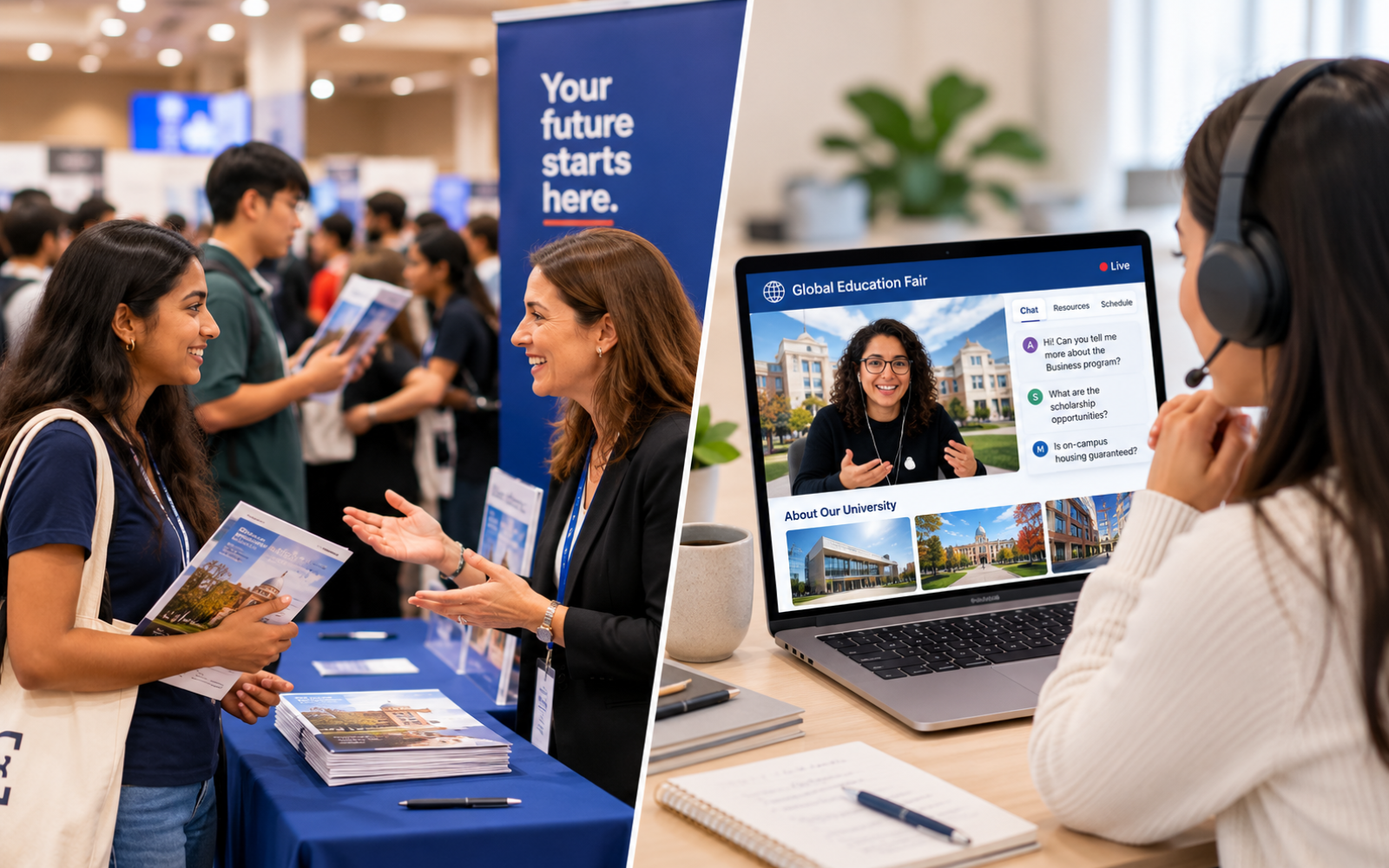
For years, universities have debated whether virtual recruitment or in-person recruitment delivers better results.
The reality is that in 2026, the most successful institutions are no longer choosing between the two. They're building recruitment strategies that combine both—using each approach where it delivers the greatest impact.
Virtual events have expanded universities' reach and made it easier to connect with students around the world. At the same time, face-to-face interactions remain one of the most effective ways to build trust with students, families, and high school counselors.
So rather than asking, "Which works better?" a more useful question is:
When should universities use virtual recruitment, and when should they invest in in-person engagement?
International student recruitment has become more competitive, more data-driven, and more student-centered.
Today's students expect universities to be accessible across multiple channels. They may first discover an institution through social media, attend a virtual information session, meet an admissions representative at their school, and continue asking questions online before submitting an application.
The student journey is no longer linear—and recruitment strategies shouldn't be either.
For a broader framework on building a successful enrollment strategy, read our guide on How to Recruit International Students Effectively.
Virtual recruitment has transformed how universities connect with prospective students.
Benefits include:
Virtual engagement is particularly valuable during the early awareness stage, when students are researching destinations and beginning to explore university options.
Examples include:
Virtual recruitment allows universities to maintain visibility long after an in-country visit has ended.
While virtual engagement has expanded opportunities, face-to-face interaction continues to provide unique advantages that technology cannot fully replace.
In-person recruitment creates opportunities to:
Many universities also find that conversations during school visits provide valuable insights into student priorities, parent concerns, and local market trends.
Those observations often influence future recruitment strategy, helping universities determine which markets offer the greatest opportunity for long-term enrollment growth. Learn more in Where Should Universities Recruit International Students in 2026?
High school visits remain one of the most effective ways to engage prospective students in an environment where they already feel comfortable.
Unlike large public fairs, school visits often allow universities to:
These interactions frequently become the foundation for ongoing partnerships.
To learn more about why these relationships matter, read Why High School Counselors Matter More Than Ever in International Student Recruitment.
One of the biggest advantages of virtual recruitment is continuity.
Students rarely make enrollment decisions after a single interaction.
Instead, universities can use virtual engagement to:
Rather than replacing travel, virtual recruitment extends the impact of every in-person interaction.
The answer depends on your goals.
Both approaches contribute differently to recruitment success.
Comparing them directly is less useful than understanding where each fits within the student journey.
Increasingly, universities are combining both approaches into a single recruitment strategy.
For example:
Before travel
During travel
After travel
This creates multiple touchpoints that help move students from awareness to enrollment.
Not every institution has the resources to travel extensively.
Fortunately, universities can still build effective recruitment strategies by combining targeted travel with virtual engagement.
Examples include:
The goal isn't necessarily to do more.
It's to make every interaction more meaningful.
International recruitment is no longer about choosing between virtual and in-person engagement.
It's about understanding the role each plays within a broader enrollment strategy.
Universities that combine relationship-building, strategic market selection, and year-round communication are better positioned to build sustainable international enrollment over time.
Technology has expanded what's possible.
Personal relationships continue to make the difference.
The institutions that thrive in 2026 will recognize that the strongest recruitment strategies don't replace one approach with another—they connect them.
Building an effective recruitment strategy involves much more than choosing between virtual and in-person engagement. Continue exploring these related resources: